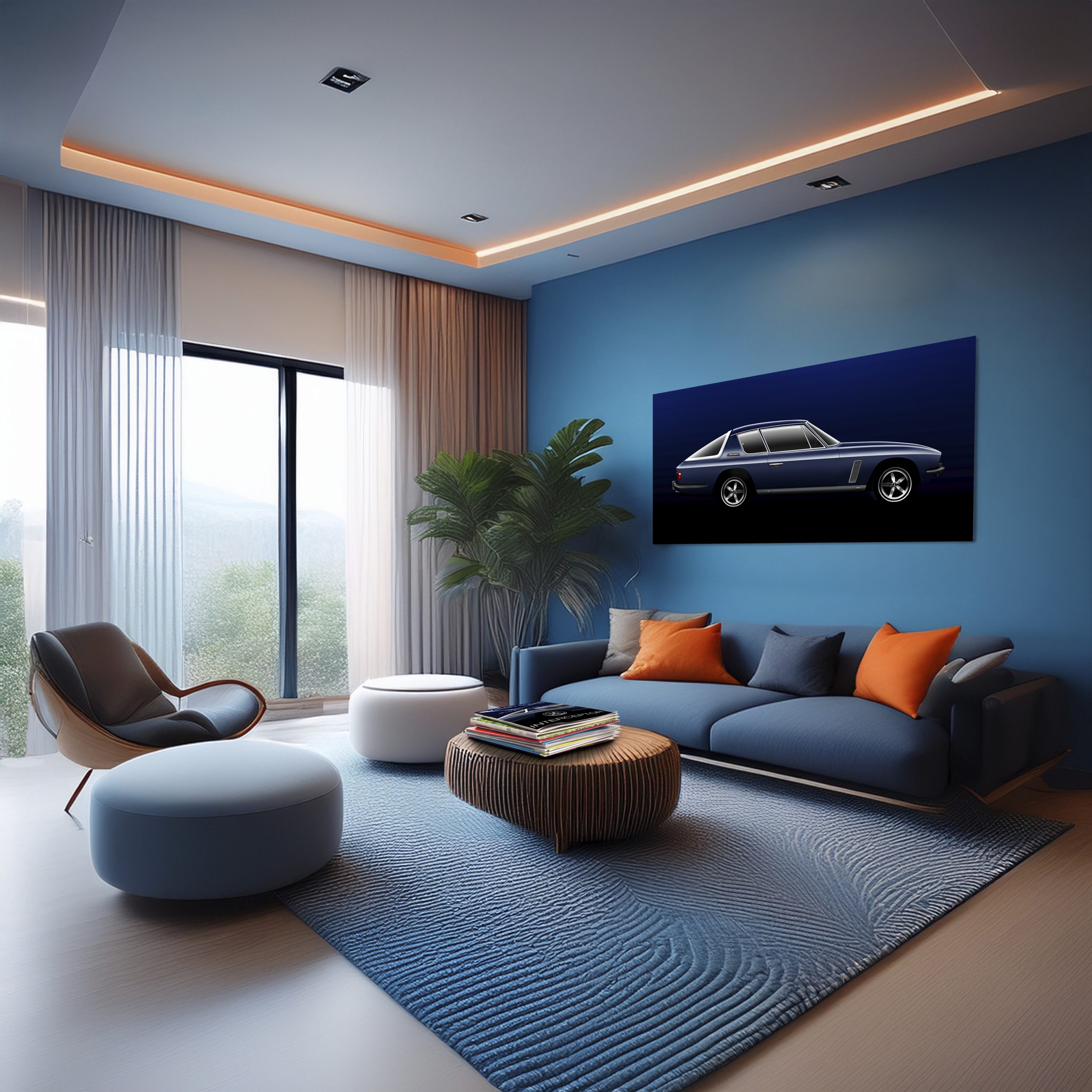
JENSEN INTERCEPTOR
Some cars are manufactured. The Jensen Interceptor was crafted. From its factory on Kelvin Way in
West Bromwich, a small team of dedicated artisans built one of the most beautiful grand touring cars ever to leave British soil , by hand, door by door, stitch by stitch.
This illustration began as something quiet and personal: a tribute to my father, whom worked at Jensen, and the craftsmen of the Black Country who poured their skill into every Interceptor that rolled through those factory gates. Men who brought these machines home. Men who made West Bromwich, briefly, the most glamorous address in the automotive world.
The MK III, introduced in 1971, represented the zenith of Jensen’s ambition, revised styling, a thundering 7.2-litre Chrysler 440 V8, standard air conditioning, and those distinctive GKN alloy wheels that gave the car a planted, purposeful stance no other British GT could match. At its peak, the SP variant pushed out a staggering 385 bhp through a six-pack triple-carburettor system, reaching 147 mph. It was the most powerful car Jensen ever built.
Italian Design, English Heart
The Interceptor’s sweeping body was penned by Carrozzeria Touring of Milan, the same studio that clothed Lamborghinis and Aston Martins, before Jensen’s craftsmen took the concept and made it entirely their own. The early bodies were assembled by Vignale in Italy after they had tweaked the design; once production moved permanently to West Bromwich, Jensen’s workforce elevated the quality to a level that silenced even the most fastidious critics.
Inside, Connolly leather, deep Wilton carpets, and a dashboard crowded with Smiths instruments created an atmosphere that was equal parts Savile Row and space programme. This was a car for captains of industry, Hollywood legends, and anyone who understood that true luxury is never accidental.
Just 6,408 second-generation Interceptors were built across the MK I, II, and III series between 1966 and 1976. The MK III remains the most produced, most celebrated, and most coveted, with 3,432 examples completed before the receivers arrived in 1975.
West Bromwich didn’t just create a great football team. From the same streets that gave us The Hawthorns came one of the most iconic GT cars ever made, the Jensen Interceptor. Hand-built on Kelvin Way. Finished with GKN alloy wheels. Driven by Frank Sinatra, John Bonham, Tony Curtis.

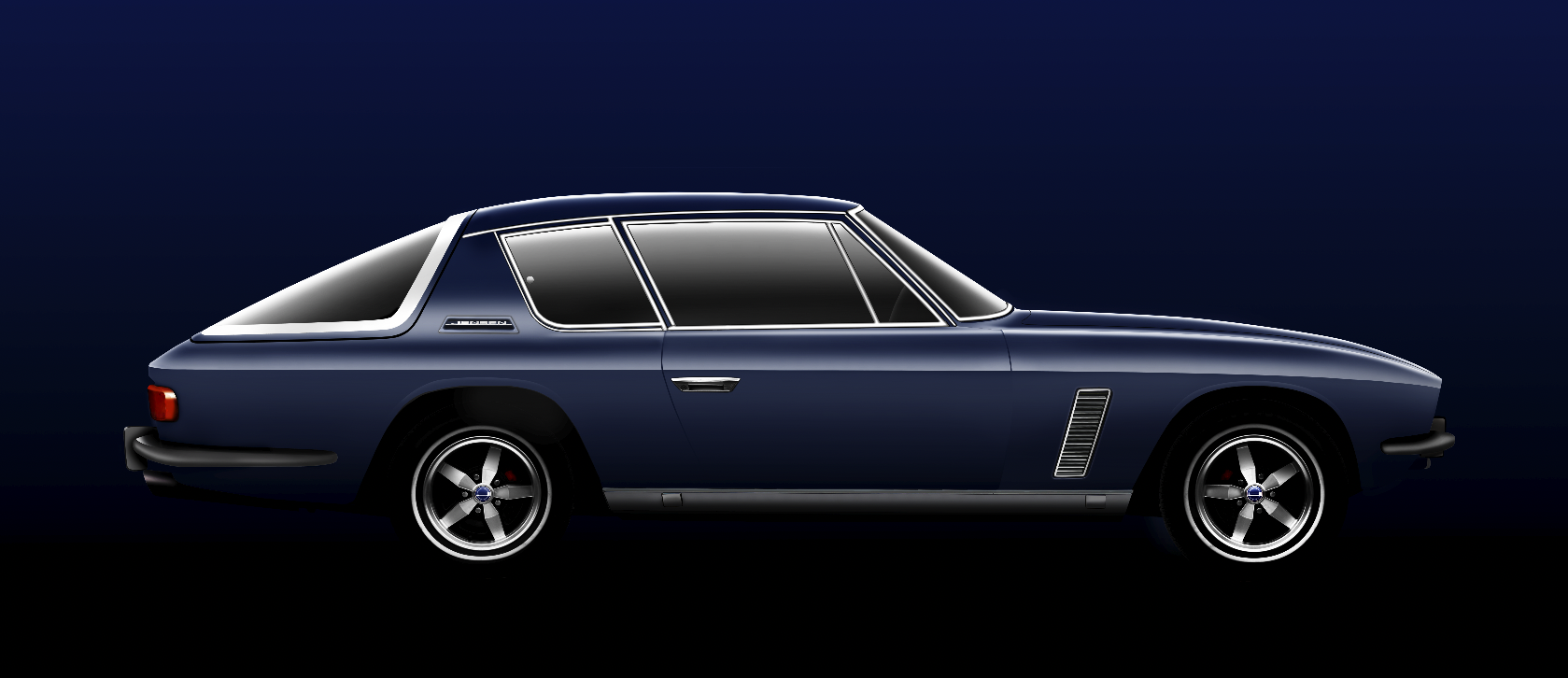
The Jensen Interceptor SP, Six Pack, was Jensen’s most formidable road car, and one of the most powerful production cars in the world when it was launched in 1971. Beneath a fully louvred bonnet sat a 7.2 litre Chrysler 440 cubic inch V8 breathing through three twin-choke Holley carburettors, developing 385 brake horsepower. Only 232 were ever built. The SP had a vinyl roof, louvred bonnet and five-spoke GKN alloy wheels, the latter a necessity rather than mere decoration. The additional power demanded wider tyres and larger ventilated brake discs, and the new 15 inch GKN alloys were the only wheels up to the task of carrying both. Details that marked it out as something rather special. Here, rendered in British Racing Green, it wears a colour steeped in motorsport history. It suits the car entirely. The SP was never subtle.
Hover Cursor Over Image
Alongside the Interceptor, Jensen produced something far more radical: the FF. Introduced in 1966, it was the first production car to combine full-time four-wheel drive with anti-lock braking—years ahead of the industry. The system, developed with Ferguson Research, delivered a level of traction and stability that no comparable grand tourer could match at the time. It fundamentally altered how power could be deployed on the road, particularly in poor conditions.
The FF’s capability quickly became part of its reputation. Contemporary accounts often claimed it would climb almost anything given sufficient grip—“a brick wall, with the right tyres” being a frequently repeated line. While exaggerated, it reflected a genuine shift in what a high-performance road car could achieve. Despite this, the complexity and cost of the system limited production to just 320 examples, making it one of the most technically ambitious and rare British cars of its era.
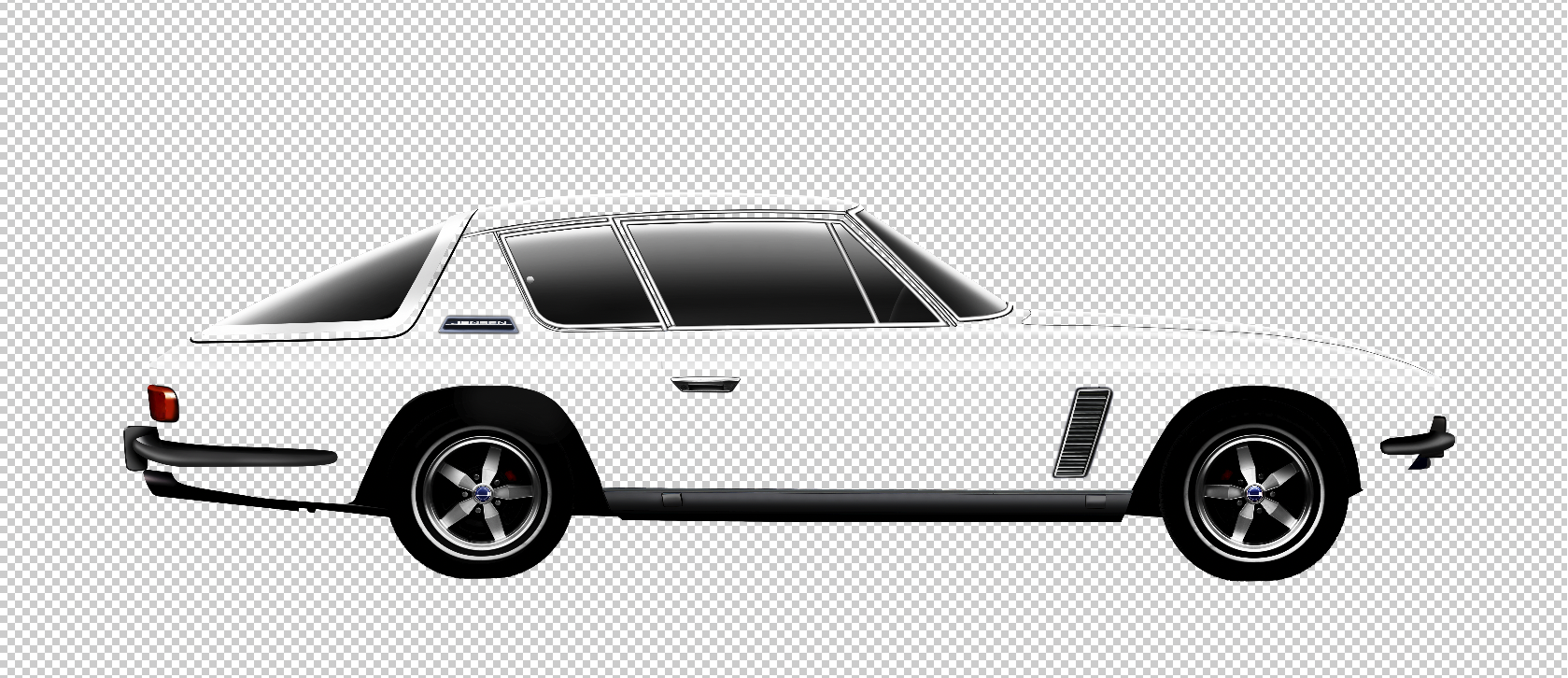
This artwork is constructed rather than captured. Built entirely in Photoshop from reference material, the image is assembled through controlled use of paths, selections, layers, and blending. It is treated as though the car were physically present in the studio, with lighting shaped and placed as it would be in a photographic environment.
The form and finish are defined by luminance rather than block colour; the car has no body colour of its own it takes its colour from the background. It exists purely as light.
The palette, drawn from West Bromwich Albion F.C combine the two West Brom icons in one image.
Each brushstroke mimics studio lighting. This technique, built from countless layers and paths and combined with a small amount of photographic imagery, wheels, tyres, vent, and badge, produces the final image.
Shaped purely from light with chameleon qualities.
Layered to perfection
Available as a limited edition aluminium print.
Printed on ChromaLuxe aluminium, an ultra-high definition metal print renowned for its extraordinary depth of colour. The process infuses dyes directly into a specially coated aluminium surface, producing prints of remarkable vibrancy and longevity. All ChromaLuxe panels are manufactured from recycled materials and are 100% recyclable.
Available in sizes from 50cm to 1.5m. Ready to hang. Gloss finish.


Each limited edition print comes with a numbered certificate of authenticity, bearing a tamper-proof hologram sticker that matches the one affixed to the reverse of the print itself.